Friday, March 21, 2014

Arbeiter Hall, West Side

Down the street 2 blocks and over one from my house is Douglas Park.  A boring, highly fenced, flat, green space with a couple basketball hoops and some playground equipment.  This is a snip from Google Maps street view. (Update - In 2016 most of the fence came down and more cement and wood chips were added around the playground equipment.)

Below is a snip from the 1895 Sanborn Fire Map showing this corner and what was here then.  A large building, a summer house, and a bandstand, set in a garden.


Here is what the building looked like.  It was built in 1880.  Arbeiter means Working man in German, and this area of the West Side was settled primarily by Germans when it first was platted.  Albert Baxter reports that it cost $20,000 to build.  Charles Hauser, who built my house, probably attended a lot of functions in this building.  The house seen at the far left is still standing in the next block.  This picture is courtesy of The Grand Rapids Historical Commission website, who copied it from the Grand Rapids Public Library's collection.

It was probably torn down in 1918, as it does not appear in the 1919 City Directory.  Maybe from anti-German sentiment from the war?

Monday, March 10, 2014

Ever Hear Of Fishers Station?

When researching J W Converse I ran across this document.  Knowing that Mr Converse was involved with the Grand Rapids and Indiana Railroad, which goes through this settlement just confused me more.  Most of his other properties were in the City of Grand Rapids.  I had to find a 1907 plat map to be able to tell just where this was.   There is pretty much nothing in this space now since the expressway and Clay Avenue went through it.


I believe Wyoming Street is now 54th Street, and the only other street left from these maps is Crippen, which now does not extend above 54th Street.

Sunday, March 9, 2014

What is the Converse Addition?

Converse is a name I continually run across in my research on the West Side of Grand Rapids.   A friend asked me to research this name in my next post, so. . . .

We will go back to the beginning of Grand Rapids.  The 1836-1837 survey, by Noah Brookfield, of a portion of the west side of the Grand River, showing sections 25 and 26, with the Baptist Mission and the Catholic Mission further south is from the Bureau of Land Management.  The Baptist Mission School was just south of what is now Bridge Street and the Catholic Mission south of Fulton Street approximately where Straight Street Park is now.  (Section 26 was where Lieutanant John W Gunnison bought the SE quarter for a proposed cranberry farm--detailed in the previous post.)  The road at the bottom, starting at the Baptist Meeting House and curving to the southwest, is the current Butterworth Avenue.  The red line through the centers of Sections 25 and 26 is the current Fulton Avenue.


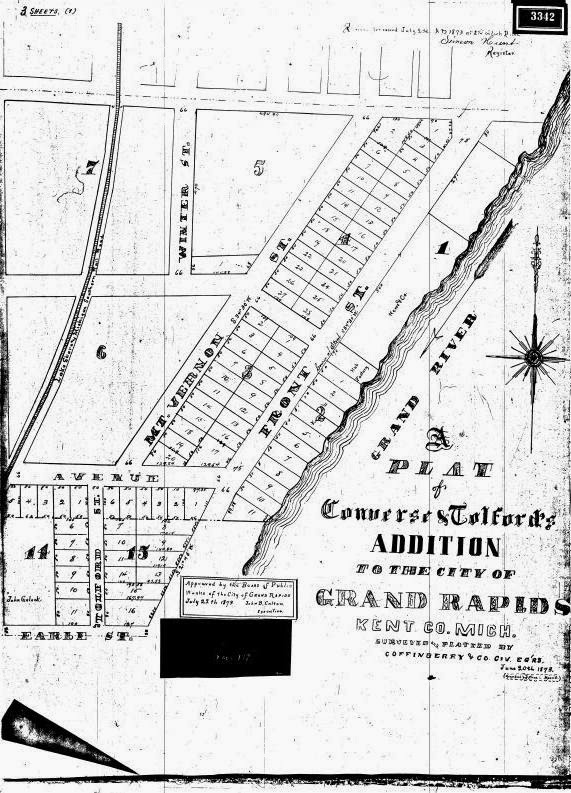
In 1883, streets and lots have been platted out and it looked like this.  Tremont (Bowery) Street and Shawmut Avenue were named for Baptist churches Converse attended in Boston.

Here are the southern pieces.

Here is what was said about that purchase by Arthur Scott White in his book, Grand Rapids On Parade, 1926; 

Shortly before the Civil War, James W. Converse, a capitalist of Boston, came to Grand Rapids seeking investments.  The prospects were so pleasing and satisfactory that he purchased a large tract on the west side of Grand River, south of Bridge Street, and proceeded by degrees to develop it.   A plat was drafted and placed on record and the lots offered for sale were disposed of quite readily.  Mr. Converse reserved an entire block in the  expectation that it would be needed by Kent County as a site for a court house and a jail. Buildings to be devoted to business purposes, and a bridge over the river at Pearl Street, were erected.  And the gypsum mills and a large tract of land adjoining, were purchased and developed by Mr. Converse.  In partnership with a man named Littlefield, a shipyard was erected and put into operation on Grand River, near Eastmanville.  A number of small craft were built and placed in service on the Great Lakes, but this enterprise proved to be unprofitable, so Mr. Converse abandoned it. He also financed railroads that were constructed between Grand Rapids and Kalamazoo, and Grand Rapids and White Cloud.  Mr. Converse was also a Columbus of the furniture industry—as several factories, including that of the Phoenix Furniture Company, were established as the result of the financial aid he supplied.  Fifty years ago Alexander Graham Bell perfected an instrument designed to transmit the tones of the human voice.  It was called the telephone.  Mr. Converse and Mr. Bell were friends, and when the latter sought financial assistance to put his invention into service, Mr. Converse invested a considerable sum.  A pair of hand 'phones used to receive and transmit messages, were forwarded to Grand Rapids to be tested on a line of wire that connected the gypsum mills with the office of the Grand Rapids Plaster Company, owned by Mr. Converse, in the city. This and other tests first helped to prove the value of the telephone."

In 1850 James W Converse, a Deacon in the Federal Street Baptist Church of Boston, and a bank president,  was called to Grand Rapids to straighten out the ownership rights of the Baptist Mission.

"Mr. Converse first visited Grand Rapids June 3, 1850, to save to the American Baptist Missionary Union its rights in the property that had been the Baptist Indian Mission reserve on the west side of the river, south of Bridge street. In that he succeeded, and afterward purchased the property; which in 1856 he caused to be platted, and which is known as the Converse Addition. In a large portion of it he caused the streets to be graded, to the great advantage of the purchasers of his lots, as well as enhancement of their value."

From Chapter 38 of Albert Baxter's History of the City of Grand Rapids, New York and Grand Rapids: Munsell & Company, Publishers, 1891.

You can read the entire biography on the Michigan GenWeb site by following this link.

A short bio from the New England Historic and Genealogical Society:

JAMES WHEATON CONVERSE 
James Wheaton Converse, a Life Member, elected in 1870, was born in Thompson, Connecticut, January 11, 1808, and died in Swampscott, Massachusetts, August 26, 1894. 

When he was six years old he removed with his parents to Woodstock, Connecticut, and two years later, to Dover, Massachusetts, and from there to Needham.  At the age of thirteen he came to Boston, where his uncles Joseph and Benjamin Converse gave him employment, and seven years later assisted him to begin business for himself in the Boylston Market.  In 1832 he entered into partnership with William Hardwick in the boot, shoe, and leather business. In 1833 he joined Isaac Field in conducting a hide and leather business under the firm name of Field and Converse.  Five years later Isaac Field retired, and his brother John Field took his place.  In 1870 Mr Converse retired from the business to give attention to his growing railroad, banking, real estate, and other interests.  He was a director of the Mechanics Bank of Boston from its organization in 1836, and its president from 1847 to 1886.  In 1870 he was appointed receiver of the old Hartford and Erie Railroad, and piloted that corporation through a perilous time.  He was president of the Boston Rubber Shoe Company, of the Colorado Smelting Company, and of the Boston Land Company.  He had large investments at the West, especially in and around Grand Rapids, Michigan.  He was liberal in his gifts to the needy and to educational and benevolent institutions.  

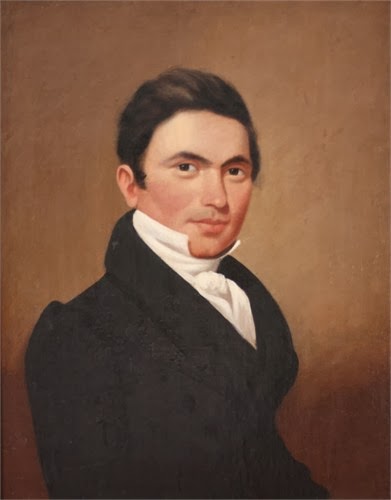
He married in 1833, Emeline, daughter of Nathan Coolidge of Boston.  She died a few years before her husband.  They had three children: James W, Jr, died in 1876; Costello Coolidge, and Emma Maria Converse. 


James Wheaton Converse married Emeline Coolidge on 5 September, 1833 in Boston, Massachusetts.  The 1860 census shows the family listed with 3 children, James Wheaton, Jr, age 16, Costello, age 11, and Emma M, age 9.  Though he never lived in Grand Rapids, James Converse was very involved in business dealings here.  When he visited in 1850 he took note of the gypsum deposits in the land he had purchased from the Baptist Mission and went into business with William Hovey to manufacture plaster.  He put up most of the money to build the Pearl Street Bridge in 1858.  He helped construct the first railroad from Kalamazoo to Grand Rapids, and on to Newaygo.  He was President of the Phoenix Furniture Company, and President and owner of the Converse Manufacturing Company in Newaygo.  He also furnished the funds to build the Second Baptist Church on the corner of California and Gold Streets.

He was given two telephones by his friend Alexander Graham Bell and brought them to Grand Rapids to set up the first telephone line in the city, from his office on Monroe Street to the plaster mine across the river, on 30 October 1877.
~~~~~~~~~~~~~~~~~~~~~~~~~~~~~~~~~~

In 1884 James and Emeline built a new house at 347 Beacon Street in Boston's Back Bay neighborhood.  The house is still standing.  This link is to a chronological article about the house. 
~~~~~~~~~~~~~~~~~~~~~~~~~~~~~~~~~~

James, James, Jr and Emeline are buried in Mount Auburn Cemetery in Cambridge, Massachusetts.  If you are interested in the genealogy of the Converse family, here is a link to a book by William Gilbert Hill.  The biography of James W Converse starts on page 161.

The following is from the book, "The City of Grand Rapids, Manufacturing Advantages, Commercial Importance", 1889, page 116, by Robert H Baker.


(The second map above shows where this factory was located.  Look for the number "5" block.)


Here is another Converse business, from the same book, page 158.


                                                           ~~~~~~~~~~~~~~~~~~~~ 

Son, James Wheaton, Jr, was made a Sergeant in the 24th MA Infantry at age 17, and had a notable career fighting under General Ambrose E Burnside.  He was later promoted to 2nd Lieutenant.


After the war Converse left the United States on an extended tour of Europe and Asia, including a journey to the Holy Land. Upon his return, he went to work for his father, who had since expanded his leather goods business into a growing manufacturing empire. In 1871, he married Harriet “Hattie” Crickmay. They settled in Grand Rapids, Mich., where Converse furthered his father’s extensive business enterprises.
Converse died suddenly five years later, at the age of 32. Doctors attributed his death to “congestion” of the brain, which may indicate a stroke or cerebral hemorrhage. His wife and two daughters survived him.

James, Jr and Harriet lived at 117 Mt Vernon, in the Converse Addition.
                                                            ~~~~~~~~~~~~~~~~~~~~


Converse family pictures copied from Ancestry.com, family genealogy of Peter McNerney.

Costello Coolidge Converse also came to Grand Rapids to help manage his father's businesses.  Among others, there was a clothespin factory on the West Side, which was rolled into the Converse Manufacturing Company, along with factories in Newaygo.  He also helped with the Grand Rapids Plaster Company.

The following is from 

Michigan Manufacturer & Financial Record, Volume 9 (Google eBook), Frank E. Carter, 1912


                                        ~~~~~~~~~~~~~~~~~~~~~~~~~~~~~~~
Emma Marie Converse married Carpet Dealer Isaac William Chick on 31 October 1877 in Boston, Massachusetts. 

They both look a little annoyed in their photographs.  They had three children by 1884, and Emma died in 1907.  Isaac died in 1929.  Photos from Mills Family Tree on Ancestry, by JamesMills54.

Both Costello's and Isaac's names show up on the document relating to the Converse Addition, above.

Sunday, March 2, 2014

The Gunnisons

I ran across an ad in an old city directory by a real estate agent named Delony Gunnison the other day.  I live on the west side near Deloney Street and Gunnison Street, and now know how they got their names.  I wanted to know more about this family.

Research on the internet showed that much has already been written about John Williams Gunnison, the father of Deloney, and this piece by Shirley DeBoer, of the Grand Rapids Historical Commission is very inclusive.  John was murdered, purportedly by Mormons dressed as Indians,  but it could also have been Paiutes, while on a mapping expedition in Utah for the US Army.  The year before, while he was in Salt Lake City, he had written an expose about the Mormon religion which angered many, and may have been one of the reasons for his murder.  The other reason may have been the hatred of the Mormons for anyone other than themselves being able to travel through Utah on their way to California.  A survey of the state would show the places best suited for railroad tracks and roads, which would bring in millions of the kind of people the Mormons didn't want in their territory.  You can read the original book using the link I gave.

Here is a transcript of a very interesting lecture given by Dr Robert Kent Fielding, entitled "John Gunnison and the Mormons:  Could John Gunnison Have Changed the Mormons?, An Analysis of Mormon History and the Path Not Taken, 1830-1857" given in January of 1994, which presents another view of the reason for the murder.  Dr Fielding has also reprinted Gunnison's book, with extensive notes and additional material, including letters written by Mrs Gunnison and William W Drummond, Federal Judge for the Utah Territory, who tried to force an investigation of the murder and blamed the Mormons, instead of the Indians, for it.

An account of what happened is detailed in a blog post by Col Dick Kindsfater.

Many places in the West bear Gunnison's name, and there is even a prairie dog named after him!

John Williams Gunnison married Martha A Delony 15 April 1841 in Camden, GA.  They soon after settled in Grand Rapids, Michigan while John was mapping the Wisconsin-Michigan border.  He eventually bought the SE quarter of section 26 in Walker Township, planning to start cranberry farming in the cedar marsh.  That never happened, and the area was known as Gunnison Swamp.

Section twenty-six, township seven north, range twelve west:
    William Peaselee, southwest quarter southeast quarter, September 6, 1845
    J. W. Gunnison, northwest quarter southeast quarter, December 11
    William Peaselee, northeast quarter southeast quarter, September 9
    J. W. Gunnison, south half north east quarter, March 1, 1848
    John Ball, north half northeast quarter, November 9, 1854

Section twenty-three, township seven north, range twelve west:

    J. W. Gunnison, northeast quarter southeast quarter, December 19, 1844.

Peaslee was John Gunnison's brother-in-law, marrying his sister, Sophira.  They moved together to Grand Rapids.

Peaslee built for John and his family of two girls and one boy, a beautiful fieldstone octagonal house on Butterworth Street,  made from indigenous rocks.  It was torn down in the 1960's.


Son, Delony Gunnison became a realtor and loan agent, selling off parcels of his father's land, after efforts were made to fill in the swamp for residential use.  In the 1870 Grand Rapids city directory, Delony and his mother were listed at 49 Pearl St.  He was listed in the 1875 Grand Rapids city directory as a real estate agent boarding at Sweet's Hotel.  I did not find him in subsequent online directories.


And, 


All of these from the book, Grand Rapids in 1874.

This shot of the 1876 map shows Gunnison property south of Butterworth that is yet undeveloped.  What is not showing is a vast area extending from the Lincoln Park line south to Butterworth and bounded on the west by what would become Garfield Avenue.  This was all the drained swamp area.

In his book, "Memorials of the Grand River Valley", 1878, Franklin Everett wrote a section about the naming of several streets.  He had this to say about Deloney and Gunnison streets:

De Lony —Mr. De Lony Gunnison, it is to be hoped you will recollect whose son you are. 
Gunnison-from Capt. Gunnison, of the U. S. Engineers. See biographical notice.

One can only wonder what prompted him to make that admonishment.

The following is also from Everett's book.

You will notice that Everett, again, made that admonishment to Deloney Gunnison.

Martha Delony Gunnison was not listed in another Grand Rapids city directory after 1870.  She died in Hawthorne, Passaic, New Jersey 18 January 1898.

Daughter Elizabeth Delony Gunnison married Dunbar O'Neill, 30 August 1870 in Grand Rapids, Michigan.  They had 5 children, 1 born in Ireland, 1 in France, and 3 in New York City.  Elizabeth lived in Grand Rapids in 1896, and in Ann Arbor, Michigan in 1898 while Genevieve was going to college.  She was listed as a widow both years.  Dunbar O'Neill died in 1898 in New York City.  Sometime before 1916, both Elizabeth and Genevieve moved to Pasadena, California where Genevieve worked as a translator.  The 1922 Voter's Registration for Los Angeles County lists them both as Democrats.  Elizabeth died in 1923.

Here is the family in New York City in 1880:
Household Gender Age Birthplace
Self Dunbar O'Neil M 34 Ireland---(occupation is Agent)
Wife Elizabeth O'Neil F 34 New York, United States
Other Mathew Gunison M 54 Georgia, United States---(this is Martha Delony Gunnison incorrectly listed)
Dau Maria Gunison F 36 Michigan, United States
Other Heny Duing M 65 Vermont, United States
Wife Sarah Duing F 60 Vermont, United States
Other Louisa Kincade F 35 Scotland
Son Travis Oneil M 8 Ireland
Son Mathew Oneil M 5 France
Dau Jane Oneil F 2 New York, United States
Dau       Earline Oneil F 0 New York, United States
Other Edword Stevens M 32 New York, United States
Other Mary Houston F 16 Ireland
Other Kate Hunnessy F 16 New York, United States                        

Daughter Maria D Gunnison was listed as a portrait artist in Newark, New Jersey in 1910.

Saturday, February 22, 2014

Major Joseph H Wonderly, Capitalist

Roney Wonderly emigrated from Switzerland sometime before 1833 and married Elizabeth Stout, a native Pennsylvanian.  They had 5 children, of which Joseph H Wonderly was the first.


Joseph H Wonderly was 30 years old in May of 1863, when he registered for the draft in Lycoming County, Pennsylvania.  He was a bookkeeper, and unmarried.  His  brothers Benjamin and Charles also served.  He had already had a stint in the militia as a Captain with Wonderly's Independent Cavalry, a militia unit, organized 9 Sept 1862 and discharged 26 Sept 1862.

 On 11 June 1863 he married Mary Almira Raiguel, and then went off to war.  
Apparently, the couple honeymooned in New York City, as this notice in the New York Times attests:
Arrivals in the City.
Published: June 26, 1863
J.H. Wonderly and wife, Williamsport, Penn.;
From:  The NY Times

In the Grand Rapids City Directory for 1870, J H Wonderly was listed as living at Sweet's Hotel.  His office, at 8 Canal, was across the street.  His saw mill, with Daniel E Little, was on Front, north of the Leonard Street Bridge.  (see pictures below of the saw mill).  He was also listed in the 1870 census in his hometown of  Williamsport, Lycoming,  PA. 

In January of 1873 the Wonderly family took a trip out of the country.

Joseph and Almira had 4 children, of which only one, Myra, lived to adulthood.  In 1879 Almira died in childbirth.  


A year later, when Joseph was 47, he married Emerett Queen Ledyard McWhorter, the widow of Francis M McWhorter, and daughter of William Bell Ledyard and Fanny Lucinda Atkins Cohoon.


Myra, Joseph, and Queen Wonderly in the summer of 1884.


From:
Cyclopedia of Michigan: historical and biographical, comprising a synopsis of general history of the state, and biographical sketches of men who have, in their various spheres, contributed toward its development (Google eBook),


Here is an archived copy of a catalog of 1881 from the Kent Furniture Manufacturing Company.


From 1873:

A BIG MICHIGAN MILL.
From the Grand Rapids Eagle we learn that Messrs. John Widdicomb and W. H. Jones, two young men of known business capacity, have purchased one-half of his two-thirds interest in the Empire Gang saw mills and pine lands of J.H. Wonderly, for $258,000, after which a joint stock company was organized with a paid up capital of $775,000, under the name of " Wonderly Lumber Company."
J. H. Wonderly and D. E. Little own stock to the amount of $258,000 each, and the balance is held by Messrs. Widdicomb and Jones.   The Empire gang mill is one of the largest in Michigan. It was built three years ago, and during the past summer was very enlarged. Its sawing capacity of 125,.000 feet per day of eleven hours.  The company possess facilities for handling logs and lumber not enjoyed by any other lumbering institution in the state. Logs are received by both river and rail in sufficient quantities to keep the mill constantly in operation throughout the year. The company owns at the present time 300,000,000 feet of pine timber, located mostly in Montcalm and Newaygo counties, easy of access and adjoining or in close proximity to large streams.
Volume I. Number 2 (November, 1873), p 80


Here is a link to a picture of the Usal Lumber Company wharf in Usal, Mendocino, CA.

I have always loved the look of the Wonderly Building, that used to sit on a corner downtown where the McKay Tower is now.  It's what inspired me to research for this post.  It was built before 1881 and was torn down about 1914--not a very long time for such a beautiful building.  I will attempt to build a timeline for this corner.

The City National Bank was listed in the 1868 Grand Rapids City Directory at the corner of Monroe and Justice.  It must be on the southeast corner, where the photographer was standing, because where it eventually was built is occupied in this 1873 photo by Remington's Custom Shirts, 9 Monroe, according to the 1872 Grand Rapids City Directory.


From the 1868 Grand Rapids City Directory - 


Not much later. . .


The 1875 Grand Rapids City Directory lists Perry Bros (John & Daniel W), hats, caps, and furs, at 27 Monroe.  (to the far right, above)  They are not listed in the 1881 Directory.

Here is the City National Bank at 1 Monroe,  this one dated before 1874.  To the right (south) can be seen the small wooden store of McGowan Brothers.   From the 1872 City of Grand Rapids Directory - McGowan Bros (Almeron & John), meat market, 5 Monroe.  By 1875,  McGowan is listed at 113 Monroe.

From the book, "Grand Rapids in 1874" - 


And this - 

I could not find either Nellis or Moran in the 1875 City Directory.  They may have leased them to others.  


This photo is dated 1875.   "Chicago & Michigan Lakeshore Railroad" reads the sign on the 4 storey building next to the bank.

Decorated for the American Centennial in 1876.  Grocers now occupy the first floor.

From the Fitch Collection, 18-2-5.179.2028.  Note the tall light tower in the background.  It was erected next to the William Haldane house.

By 1881 Joseph H Wonderly and his Kent Furniture Manufacturing Company is listed at 25 Monroe.  The building is now 6 storeys high.  Looking down Pearl Street on the left you can see the hill where the Daniel Ball residence is, and past it, the new, 1883, Houseman Building.
From "Industries of Grand Rapids, Her Relations as a Centre of Trade, Business Houses and Manufacturing Establishments", J. M. Elstner & Co., Publishers, 1887.

From the book, The City of Grand Rapids Manufacturing Advantages, Commercial Importance, by Robert H Baker, 1889.  This renovation was done by Sidney J Osgood, and this is found on page 21:  "He is now preparing plans for a $25,000 Masonic temple at Cadillac and has on hand the remodeling of the Wonderly Block in this city at a cost $30,000."


This beautiful shot is from 1890 and courtesy of the Grand Rapids Library Fitch collection.

I think this is from 1891, and the building has been beautified with turrets and towers.


About 1900.  The fire escapes have been added and the first floor of the bank building has been changed.

Here is a beautiful shot of the right side of the building, probably taken on the same day (dated 1908) from Shorpy.  Click to see it.

By 1920 the Grand Rapids National City Bank occupies the corner.  It will eventually be acquired by Frank McKay and increased to 18 stories in 1925.  It was built by Hauser, Owen, Ames before 1916.


The above series of photos is from the Grand Rapids Public Museum's collection via Robert Kline's site.

                          ~~~~~~~~~~~~~~~~~~~~~~~~~~~~~~~~~~~
In 1892 there was a general depression in the economy and the US Senate Committee on Finance were gathering information from manufacturers to see if a tariff on foreign goods would help the economy.  The Grand Rapids Corset Company sent in this report.  J H Wonderly was the President.


J. H. Wonderly
Friday, August 9, 1895
Obituary
B. F. Wonderly, the undertaker, yesterday received the sad intelligence of the death of his brother, J. H. Wonderly at Old Mission, Mich, yesterday morning. Deceased was a resident of Grand Rapids, Mich, and was interested in the California Red Wood business. He was also President of the Kent Furniture Company and the Grand Rapids Corset Company. He had resided in Michigan for twenty years, having moved there from Williamsport. Deceased was 62 years of age and his wife and one daughter survive. His aged mother, Elizabeth Wonderly, one sister, Mrs. Celia Stuart of Catasauqua and three brothers; B. F. Wonderly of this city, Charles Wonderly of Grand Rapids and William Wonderly of Catasauqua also survive. Mr. Wonderly was a native of Nazareth, but when yet a young man located in Williamsport, and subsequently went to Grand Rapids, Mich. Where he became one of the leading citizens.


Joseph H Wonderly is buried on the Valley City side of Oakhill Cemetery in Grand Rapids, Michigan.