Wednesday, April 23, 2014

The Haldanes


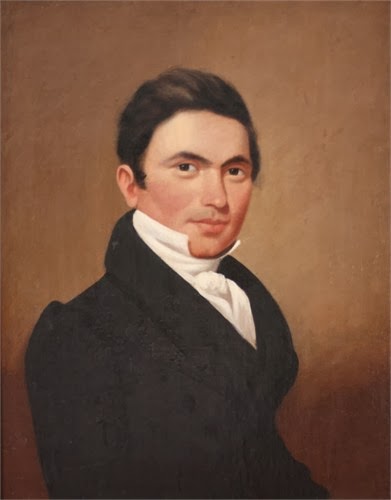
William "Deacon" Haldane from the Grand Rapids Public Library Collection.

Anyone reading about early Grand Rapids runs across the name William N "Deacon" Haldane pretty frequently.  He is credited as having the first chair manufactory in Grand Rapids.  He was born 5 May 1807 in Delphi, Delaware County, New York, to Scottish emigrants, James Haldane and Elizabeth Preston.  In 1810, the Haldane family consisted of James and Elizabeth, both aged between 26 and 44, Elizabeth Livingstone, born 28 January 1809, and William N.  William's father died when he was 8 years old, in 1816, and by then the family had grown by two more boys, Andrew, born 8 January 1811, and James Maxwell, born 15 June 1813.  Elizabeth died 13 April 1865 at age 87, but I do not know where.  She was living with her daughter with 2nd husband, John Pierson, Rosanna Payne, in Koshkonong, Jefferson County, Wisconsin, in 1850.  Rosanna Pierson Allen Payne was born 10 November 1818 and married an Allen before 1838.  She had two children:  Elizabeth and Philander  After Mr Allen died, she married James Payne in 1845 and had six more children.  Rosanna and James Payne eventually ended up in Salem, Marion County, Oregon, where they died in 1889 and 1899.  I do not know if Elizabeth Preston Haldane Pierson had any more children, or what became of daughter, Elizabeth Livingstone Haldane.

William started working out with other farmers to earn money for his family, and, after he completed school at age 14, apprenticed himself to a carpenter and joiner to learn a trade.  He continued going to school as well as working, and became a journeyman contractor and builder at age 20.  He employed his two brothers as apprentices in his fledgling business.  William went to Painesville, Erie, Ohio in 1831 to build a church, and boarded with George Babcock.  George's niece, Sarah L Tomlinson, born in Gaines Twp, Orleans, New York 29 March 1812, was living with them at the time and she and William married there 7 August 1831.  A child, William H, was born in 1833, but only lived a month.  When William and Sarah moved to Grand Rapids before July, 1836, they brought his body with them and buried him in Fulton Street Cemetery. There was another child born and died young in Grand Rapids Brother Andrew Haldane died in Buffalo, New York on 6 September 1835, and was the first burial in Fulton Street Cemetery.  The record is not clear as to all the comings and goings of the family, and perhaps Andrew had been in Grand Rapids and gone back home for some reason.  Brother James Maxwell Haldane worked as a contractor in Grand Rapids until his early death 14 September 1856 of consumption.  He is also buried in Fulton Street Cemetery.  He lived on a farm on the lower West Side near the river.
From the Grand Rapids Eagle, 29 October 1857.

In 1838 William and Sarah went to Summit County, Ohio and lived a few years, returning to Grand Rapids in 1841 with a circular saw and a lathe, the first machinery used here to build furniture.  Brother James M also traveled to Ohio, but to Medina County, and there married Emeline E McIntyre.  James and Emeline only had one son, Arthur William, who was born in 1844.  After 1870, I can find no further trace of him, and Ruebey Statira Tomlinson Ferris says that he died young.


Albert Baxter says this about James:  "SASH, DOORS AND BLINDS. In the beginnings of the village the skilled carpenter and joiner usually carried in his chest the tools necessary for the making of mouldings, casings, sash, doors and blinds. These things were plainer and simpler in construction than now, fifty years ago, when all the work was patiently wrought by hand. Haldane, Burnett, Woodward, Covell, Blakely, and other early comers of the craft, usually peformed (sic) their own work in this line. James M. Haldane was perhaps the first to make a specialty of manufacturing window sash and blinds to be kept on hand for sale. His shop was on Prospect Hill in January, 1842, where he advertised to supply farmers and others at short notice."

William and Sarah Haldane had another male child, F H, who is buried with them in Fulton Street Cemetery with no dates.  To make up for their childlessness, they helped raise two of Sarah's nieces, Jane Tomlinson, born 6 July 1835, daughter of oldest brother, David Tomlinson, who married William Perkins of Buffalo, New York, and Reubey Statira Tomlinson, born in 1858, daughter of another brother, John Tomlinson, who married Jay Floyd Ferris, founder of Ferris Coffee & Nut.  (There was a note by Reubey that a daughter of Rosana Payne had visited the Haldanes before 1875, but was not "chosen" to be a member of the family as she was.)

The following biography is from American Biographical History of Eminent and Self-Made Men, Michigan Volume Two, Fifth Congressional District, Cincinnati:  Western Biographical Publishing Company, 1878, p 46-7


Here is what Dwight Goss said about William Haldane in his History of Grand Rapids and its industriesChicago, C. F. Cooper & co., 1906, p 180 :  "William Haldane was among the pioneer cabinet-makers here. He came in 1836; and in 1837 built a frame dwelling on Prospect Hill, southeast corner of Ottawa and Pearl streets, where now is the Michigan Trust Building. Subsequently he erected a brick house on the same spot, which was twice extended downward, on account of street excavations through the hill. Mr. Haldane was well known and respected by all the old residents. He died March 5, 1898."

We are looking south down Ottawa Street and the cross street is Pearl.  The house on the left is Haldane's, circa 1865, and has already been "extended downwards" once by the grading of the road, shown in the picture.  The original wooden Haldane house, shown at the top of this post, was moved across Ottawa street, but is not identifiable in the picture.  It was later moved one block north to the corner of Ottawa and Lyon, and torn down in 1888.  Deacon lived in that house and ran his business from there until 1847, when he moved the business to a building on the east canal and ran his machinery by water power.  In 1853 he had a shop next to the Sweet's Hotel  on Canal (Monroe) where he used steam power.  In July of 1854 Deacon partnered with E W Winchester in the furniture business for a year.  At this time he also built the Gothic cottage, pictured above, with cream colored bricks brought from Milwaukee, and was the first fine brick residence in the community.  In his back yard Deacon grew grapes to make wine and became something of a local wine connoisseur, and was a member of the Grand River Horticultural Society for the rest of his life.

This house and property was sold in 1872 for $11,000 to the city for a proposed city hall.  The city sold it to Daniel H Waters on 5 July 1885, and bought the land where the city hall was eventually built.  The property next to Sweet's Hotel was furnished with a large brick building which was later sold to I M Weston who incorporated it into the Weston building.  With the proceeds of the sale, Deacon bought a lot at 55 Jefferson Avenue, opposite the foot of State Street, and built a brick house where the family lived until their deaths.  It was later the Lyzen Funeral Home.


This is 1882 with the fire bell tower.  Can you imagine how the bell sounded in that house?  Later arc lights were added to the tower for street lighting.  The house has been "extended downward" again and is showing signs of disrepair since Haldane no longer owns it.  You can also see this tower in the banner picture at the top of the page, and the roof of the house.


The same house in 1888.  The fire bell has been moved to the new city hall building clock tower.

The Houseman building, finished in 1883, is the building that can be seen to the left of the Haldane house, above, though the Haldane house does not show in this 1888 shot.  It looks like there is an empty lot there.  The long street is Ottawa, with Pearl crossing it on the right, and the cross street in the left front is Lyon.  To the right had been the house of William H Powers.

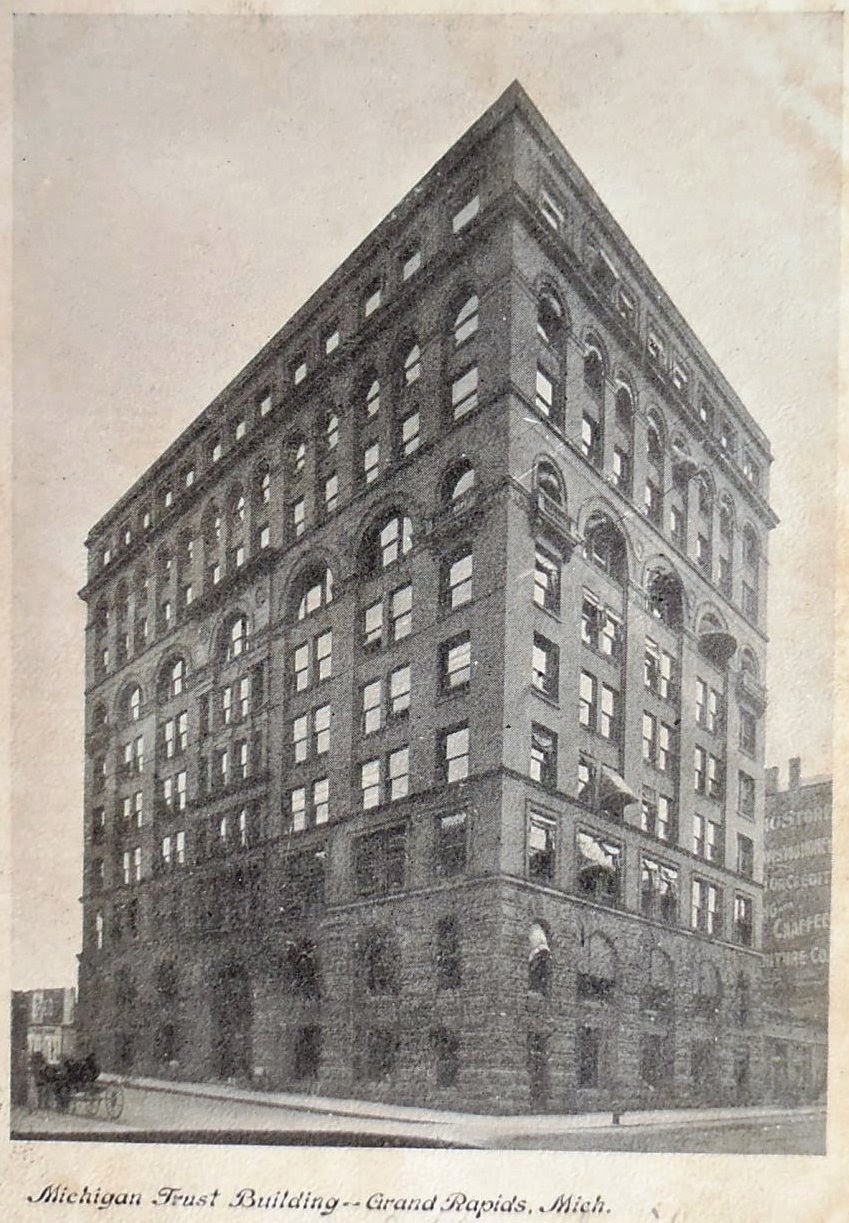
The Michigan Trust Building, built in 1892, at 40 Pearl Street NW, on the site of the Haldane house.  It gained a little width and height by 1916.
~~~~~~~~~~~~~~~~~~~~~~~~~~~~~~~~~~~~~~~~~~~~~~~~~

Albert Baxter has this to say about another talent of William Haldane:  "A FEW CUTTERS. The pioneer who needed a sleigh, if he had some carpenters' tools, generally managed to hew out a rough and rather heavy one for himself, and with a little aid from the nearest blacksmith made it serviceable; though sometimes a "pung" was constructed with no ironing. Undoubtedly the first cutters made and marketed here were built by a cabinet maker-William Haldane. Wishing to take a winter trip to Ohio, in the fall of I837, he made for himself a "gooseneck" cutter, with a square box, and tall knees the better to get over low bushes or stumps. But immediately came along the young man who kept the first bookstore in Kent and wanted to buy it. Haldane sold it, and proceeded to make another. This caught the eye of another ambitious young merchant, near the Eagle Hotel, who purchased it, giving $5 extra for a little nicer finish. A third cutter was disposed of similarly, each buyer advancing the price, to outdo his predecessor. Those were sold at $75 each and upward-such vehicles as now, if they were fashionable, would be marketed for perhaps $20 or $25."

And this:  "MANUFACTURE OF FURNITURE AND CABINET WARES. To most people of the present day it may seem incredible that, but little more than half a century ago, the rough slab bench or the three-legged stool, was not infrequently an article of kitchen furniture, but such is the fact. The pioneer.who had an ax and saw and jackknife and auger deemed himself qualified to fit out his cabin with a plain table, a square-post bedstead, and a few seats, to begin housekeeping. Not many brought to their new homes in the woods a good outfit; but soon they saw the day of improvement. About 1835 came into the settlement at Grand Rapids two or three who set up foot-lathes and were instrumental in the change from the era of square work to turned work. When William Haldane built his house in 1837, no sooner was the rough sheathing on the frame, and the roof shingled, than he moved in upon a rough board floor. Mrs. Haldane relates that blankets sufficed to cover the windows temporarily, and were not very inconvenient doors. Her husband, being a mechanic, made a door and some sash, and traded other specimens of his work for 8 by 10 window glass. He cut from an old bootleg hinges for his door. They put up a squarepost bedstead, put in the bedcord, put thereon a straw bed and retired, feeling that they had a comfortable home of their own; and she says she does not know but they were as happy in those days as they have ever been. The house was at the head of what was then and for more than twenty years called Justice street, now the southeast corner of Pearl and Ottawa streets, and here for many years he carried on the cabinet making business."

Tuesday, April 15, 2014

The Converse Mounds and the West Side Court House

The Converse Mounds

In the section on Archaelogy in his History of the City of Grand Rapids, Albert Baxter wrote:
"The burial grounds of the Indians at the village below the Pearl street bridge, west side, comprised also a number of mounds, which since have been defaced and leveled in the construction of streets. And there, as elsewhere, in some of them it was found that beneath the buried remains of Indians of the tribes found here by the whites, were other and earlier deposits of similar character, in which were relics of the origin of which these later tribes professed to have no knowledge. The grading and working of streets on the west side of these rapids, displaced most of that portion of the mounds above the general level, and therein were found a variety of beads, rings, bracelets, and silver trinkets, along with the skeletons exhumed. Usually the bones were reburied, and the other articles appropriated by the discoverers."

"A number of them were on the west side of the river within the city limits. In grading these were only cut down to about the general level, and in this process many bones and implements of comparatively recent deposit were found. But it was in deeper excavating, for sewerage and for laying gas and water pipes, that older and more interesting articles were discovered-often in deposits directly under those of the burial places of the Indian tribes that were here when the white people came. Four mounds silver (about thirteen pounds), and one of copper (about fourteen pounds), with bone husking pegs, copper axes, bear's teeth  with holes drilled in them, and other curiosities, which Mr. Coffinberry sold to the Curator of the Peabody Museum in Salem, Mass., for $200. An offer of $100 was made by the Smithsonian Institution for the Norton mound relics; but these, under previous stipulation, belonged to the Kent Scientific Institute. With all these deposits were found human bones that had the appearance of having been divested of flesh before they were placed in the pits or cists; generally the long bones with the relics and the craniums on top, upright in position and very near together. Louis Campau, the pioneer fur trader here, said that the natives had no knowledge of the origin of these mounds; only knew them to be the work of human hands; had great veneration for them, and a propensity for being buried on or near them. They were mute evidences of earlier occupation, probably by a different race of people."


 "In 1882, in leveling a mound near the west end of Pearl street bridge, skeletons were exhumed; and there Mr. Coffinberry found a copper spear point or needle, six or seven inches long, one-fourth of an inch in diameter in the middle, tapering to a smooth rounded point at one end and to a sort of flattened shank at the other. Silver beads also were dug up. He thought these antedated the Ottawa and Chippewa occupation here, or that of any tribe -of the-past two or three centuries. A writer in a Detroit paper, describing similar needles found in Canada, suggested that they were Indian sewing needles, used in the construction of bark canoes, garments, and other things, and called attention to a similarity in shape between them and the sewing machine needle of the present day."

I will attempt to interpret this map drawn in 1836-7 by Noah Brookfield.  The first horizontal line is Bridge Street, below that currently Allen Steet/Sibley Street, then current Lake Michigan Drive.  The ferry shown started at Ferry Street on the east side and terminated in an indian trail that turned into Stocking Street.  There is a railroad bridge there, now.  The next horizontal down is West Fulton, then Wealthy Avenue.  The vertical streets are, from the river, current Front Street, then West Division now Seward Street, then Straight Street,  for a long time the western boundary of Grand Rapids.

The Court House on the West Side


This map, courtesy of Barbara Vandermark, was drawn by Henry Hart in 1853.  Notice that the streets have different names than they are now known by.  I was intrigued by the drawing of the court house and jail on the south side of Bridge Street, and Court Street, which was later changed to Tremont, and then to Douglas.  I had to search quite a while to find out about that building, but finally found a reference in Baxter's History of  the City of Grand Rapids:

"KENT COUNTY JAIL. The first Kent County Jail was in one corner of the Court House on the Public Square, that was built in 1838. Under an act of the Legislature, March 28, 1838, it was provided that prisoners apprehended in Ionia and Ottawa counties should be placed in the Kent county jail. After that building burned in 1844, until 1854, the county was dependent upon rented quarters for a jail. For some years the cellar under a building which stood on the east side of Canal street, between Lyon and Pearl, was used for jail purposes. During the ten years after the original jail was burned, the county was to considerable expense for the keeping of its prisoners in Barry and Ottawa counties. In May, 1847, the Supervisors advertised for proposals to build a county jail, but nothing came of it. In March, 1851, proposals were invited for a site for a jail, and also for the building of one, and in May of the same year the County Clerk invited proposals for the building of a jail and Sheriff's residence. This resulted in the procurement of a site a few rods south of Bridge street, west of Front street, and the building thereon of a two-story frame residence for the Sheriff, with a jail at the rear, of heavy oak plank, sheathed on the inside with sheet iron. This was not a remarkably secure place of confinement, and there were several escapes therefrom. It was occupied and used, however, from the beginning of 1855 until March, 1872."

In an interesting turn of events, Harriet street, in the map above was actually named Court Street for a while, and then changed to Scribner.


Friday, March 21, 2014

Arbeiter Hall, West Side

Down the street 2 blocks and over one from my house is Douglas Park.  A boring, highly fenced, flat, green space with a couple basketball hoops and some playground equipment.  This is a snip from Google Maps street view. (Update - In 2016 most of the fence came down and more cement and wood chips were added around the playground equipment.)

Below is a snip from the 1895 Sanborn Fire Map showing this corner and what was here then.  A large building, a summer house, and a bandstand, set in a garden.


Here is what the building looked like.  It was built in 1880.  Arbeiter means Working man in German, and this area of the West Side was settled primarily by Germans when it first was platted.  Albert Baxter reports that it cost $20,000 to build.  Charles Hauser, who built my house, probably attended a lot of functions in this building.  The house seen at the far left is still standing in the next block.  This picture is courtesy of The Grand Rapids Historical Commission website, who copied it from the Grand Rapids Public Library's collection.

It was probably torn down in 1918, as it does not appear in the 1919 City Directory.  Maybe from anti-German sentiment from the war?

Monday, March 10, 2014

Ever Hear Of Fishers Station?

When researching J W Converse I ran across this document.  Knowing that Mr Converse was involved with the Grand Rapids and Indiana Railroad, which goes through this settlement just confused me more.  Most of his other properties were in the City of Grand Rapids.  I had to find a 1907 plat map to be able to tell just where this was.   There is pretty much nothing in this space now since the expressway and Clay Avenue went through it.


I believe Wyoming Street is now 54th Street, and the only other street left from these maps is Crippen, which now does not extend above 54th Street.

Sunday, March 9, 2014

What is the Converse Addition?

Converse is a name I continually run across in my research on the West Side of Grand Rapids.   A friend asked me to research this name in my next post, so. . . .

We will go back to the beginning of Grand Rapids.  The 1836-1837 survey, by Noah Brookfield, of a portion of the west side of the Grand River, showing sections 25 and 26, with the Baptist Mission and the Catholic Mission further south is from the Bureau of Land Management.  The Baptist Mission School was just south of what is now Bridge Street and the Catholic Mission south of Fulton Street approximately where Straight Street Park is now.  (Section 26 was where Lieutanant John W Gunnison bought the SE quarter for a proposed cranberry farm--detailed in the previous post.)  The road at the bottom, starting at the Baptist Meeting House and curving to the southwest, is the current Butterworth Avenue.  The red line through the centers of Sections 25 and 26 is the current Fulton Avenue.


In 1883, streets and lots have been platted out and it looked like this.  Tremont (Bowery) Street and Shawmut Avenue were named for Baptist churches Converse attended in Boston.

Here are the southern pieces.

Here is what was said about that purchase by Arthur Scott White in his book, Grand Rapids On Parade, 1926; 

Shortly before the Civil War, James W. Converse, a capitalist of Boston, came to Grand Rapids seeking investments.  The prospects were so pleasing and satisfactory that he purchased a large tract on the west side of Grand River, south of Bridge Street, and proceeded by degrees to develop it.   A plat was drafted and placed on record and the lots offered for sale were disposed of quite readily.  Mr. Converse reserved an entire block in the  expectation that it would be needed by Kent County as a site for a court house and a jail. Buildings to be devoted to business purposes, and a bridge over the river at Pearl Street, were erected.  And the gypsum mills and a large tract of land adjoining, were purchased and developed by Mr. Converse.  In partnership with a man named Littlefield, a shipyard was erected and put into operation on Grand River, near Eastmanville.  A number of small craft were built and placed in service on the Great Lakes, but this enterprise proved to be unprofitable, so Mr. Converse abandoned it. He also financed railroads that were constructed between Grand Rapids and Kalamazoo, and Grand Rapids and White Cloud.  Mr. Converse was also a Columbus of the furniture industry—as several factories, including that of the Phoenix Furniture Company, were established as the result of the financial aid he supplied.  Fifty years ago Alexander Graham Bell perfected an instrument designed to transmit the tones of the human voice.  It was called the telephone.  Mr. Converse and Mr. Bell were friends, and when the latter sought financial assistance to put his invention into service, Mr. Converse invested a considerable sum.  A pair of hand 'phones used to receive and transmit messages, were forwarded to Grand Rapids to be tested on a line of wire that connected the gypsum mills with the office of the Grand Rapids Plaster Company, owned by Mr. Converse, in the city. This and other tests first helped to prove the value of the telephone."

In 1850 James W Converse, a Deacon in the Federal Street Baptist Church of Boston, and a bank president,  was called to Grand Rapids to straighten out the ownership rights of the Baptist Mission.

"Mr. Converse first visited Grand Rapids June 3, 1850, to save to the American Baptist Missionary Union its rights in the property that had been the Baptist Indian Mission reserve on the west side of the river, south of Bridge street. In that he succeeded, and afterward purchased the property; which in 1856 he caused to be platted, and which is known as the Converse Addition. In a large portion of it he caused the streets to be graded, to the great advantage of the purchasers of his lots, as well as enhancement of their value."

From Chapter 38 of Albert Baxter's History of the City of Grand Rapids, New York and Grand Rapids: Munsell & Company, Publishers, 1891.

You can read the entire biography on the Michigan GenWeb site by following this link.

A short bio from the New England Historic and Genealogical Society:

JAMES WHEATON CONVERSE 
James Wheaton Converse, a Life Member, elected in 1870, was born in Thompson, Connecticut, January 11, 1808, and died in Swampscott, Massachusetts, August 26, 1894. 

When he was six years old he removed with his parents to Woodstock, Connecticut, and two years later, to Dover, Massachusetts, and from there to Needham.  At the age of thirteen he came to Boston, where his uncles Joseph and Benjamin Converse gave him employment, and seven years later assisted him to begin business for himself in the Boylston Market.  In 1832 he entered into partnership with William Hardwick in the boot, shoe, and leather business. In 1833 he joined Isaac Field in conducting a hide and leather business under the firm name of Field and Converse.  Five years later Isaac Field retired, and his brother John Field took his place.  In 1870 Mr Converse retired from the business to give attention to his growing railroad, banking, real estate, and other interests.  He was a director of the Mechanics Bank of Boston from its organization in 1836, and its president from 1847 to 1886.  In 1870 he was appointed receiver of the old Hartford and Erie Railroad, and piloted that corporation through a perilous time.  He was president of the Boston Rubber Shoe Company, of the Colorado Smelting Company, and of the Boston Land Company.  He had large investments at the West, especially in and around Grand Rapids, Michigan.  He was liberal in his gifts to the needy and to educational and benevolent institutions.  

He married in 1833, Emeline, daughter of Nathan Coolidge of Boston.  She died a few years before her husband.  They had three children: James W, Jr, died in 1876; Costello Coolidge, and Emma Maria Converse. 


James Wheaton Converse married Emeline Coolidge on 5 September, 1833 in Boston, Massachusetts.  The 1860 census shows the family listed with 3 children, James Wheaton, Jr, age 16, Costello, age 11, and Emma M, age 9.  Though he never lived in Grand Rapids, James Converse was very involved in business dealings here.  When he visited in 1850 he took note of the gypsum deposits in the land he had purchased from the Baptist Mission and went into business with William Hovey to manufacture plaster.  He put up most of the money to build the Pearl Street Bridge in 1858.  He helped construct the first railroad from Kalamazoo to Grand Rapids, and on to Newaygo.  He was President of the Phoenix Furniture Company, and President and owner of the Converse Manufacturing Company in Newaygo.  He also furnished the funds to build the Second Baptist Church on the corner of California and Gold Streets.

He was given two telephones by his friend Alexander Graham Bell and brought them to Grand Rapids to set up the first telephone line in the city, from his office on Monroe Street to the plaster mine across the river, on 30 October 1877.
~~~~~~~~~~~~~~~~~~~~~~~~~~~~~~~~~~

In 1884 James and Emeline built a new house at 347 Beacon Street in Boston's Back Bay neighborhood.  The house is still standing.  This link is to a chronological article about the house. 
~~~~~~~~~~~~~~~~~~~~~~~~~~~~~~~~~~

James, James, Jr and Emeline are buried in Mount Auburn Cemetery in Cambridge, Massachusetts.  If you are interested in the genealogy of the Converse family, here is a link to a book by William Gilbert Hill.  The biography of James W Converse starts on page 161.

The following is from the book, "The City of Grand Rapids, Manufacturing Advantages, Commercial Importance", 1889, page 116, by Robert H Baker.


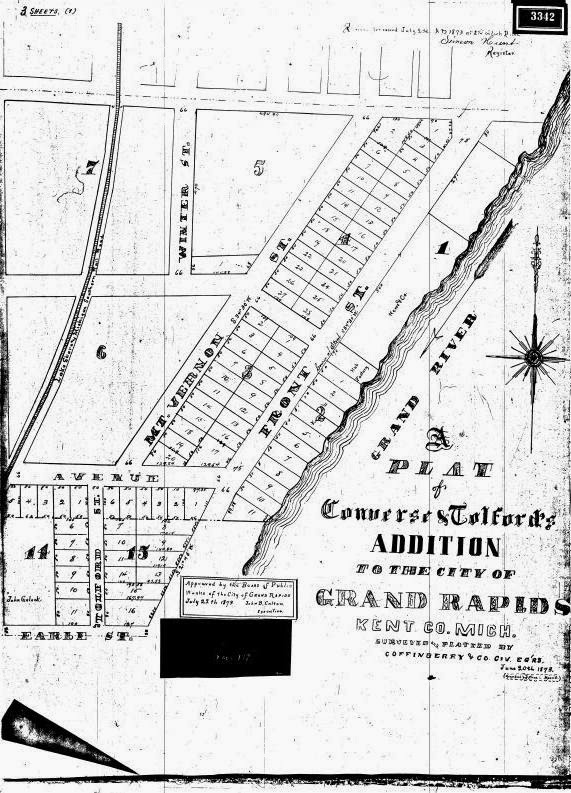
(The second map above shows where this factory was located.  Look for the number "5" block.)


Here is another Converse business, from the same book, page 158.


                                                           ~~~~~~~~~~~~~~~~~~~~ 

Son, James Wheaton, Jr, was made a Sergeant in the 24th MA Infantry at age 17, and had a notable career fighting under General Ambrose E Burnside.  He was later promoted to 2nd Lieutenant.


After the war Converse left the United States on an extended tour of Europe and Asia, including a journey to the Holy Land. Upon his return, he went to work for his father, who had since expanded his leather goods business into a growing manufacturing empire. In 1871, he married Harriet “Hattie” Crickmay. They settled in Grand Rapids, Mich., where Converse furthered his father’s extensive business enterprises.
Converse died suddenly five years later, at the age of 32. Doctors attributed his death to “congestion” of the brain, which may indicate a stroke or cerebral hemorrhage. His wife and two daughters survived him.

James, Jr and Harriet lived at 117 Mt Vernon, in the Converse Addition.
                                                            ~~~~~~~~~~~~~~~~~~~~


Converse family pictures copied from Ancestry.com, family genealogy of Peter McNerney.

Costello Coolidge Converse also came to Grand Rapids to help manage his father's businesses.  Among others, there was a clothespin factory on the West Side, which was rolled into the Converse Manufacturing Company, along with factories in Newaygo.  He also helped with the Grand Rapids Plaster Company.

The following is from 

Michigan Manufacturer & Financial Record, Volume 9 (Google eBook), Frank E. Carter1912


                                        ~~~~~~~~~~~~~~~~~~~~~~~~~~~~~~~
Emma Marie Converse married Carpet Dealer Isaac William Chick on 31 October 1877 in Boston, Massachusetts. 

They both look a little annoyed in their photographs.  They had three children by 1884, and Emma died in 1907.  Isaac died in 1929.  Photos from Mills Family Tree on Ancestry, by JamesMills54.

Both Costello's and Isaac's names show up on the document relating to the Converse Addition, above.

Sunday, March 2, 2014

The Gunnisons

I ran across an ad in an old city directory by a real estate agent named Delony Gunnison the other day.  I live on the west side near Deloney Street and Gunnison Street, and now know how they got their names.  I wanted to know more about this family.

Research on the internet showed that much has already been written about John Williams Gunnison, the father of Deloney, and this piece by Shirley DeBoer, of the Grand Rapids Historical Commission is very inclusive.  John was murdered, purportedly by Mormons dressed as Indians,  but it could also have been Paiutes, while on a mapping expedition in Utah for the US Army.  The year before, while he was in Salt Lake City, he had written an expose about the Mormon religion which angered many, and may have been one of the reasons for his murder.  The other reason may have been the hatred of the Mormons for anyone other than themselves being able to travel through Utah on their way to California.  A survey of the state would show the places best suited for railroad tracks and roads, which would bring in millions of the kind of people the Mormons didn't want in their territory.  You can read the original book using the link I gave.

Here is a transcript of a very interesting lecture given by Dr Robert Kent Fielding, entitled "John Gunnison and the Mormons:  Could John Gunnison Have Changed the Mormons?, An Analysis of Mormon History and the Path Not Taken, 1830-1857" given in January of 1994, which presents another view of the reason for the murder.  Dr Fielding has also reprinted Gunnison's book, with extensive notes and additional material, including letters written by Mrs Gunnison and William W Drummond, Federal Judge for the Utah Territory, who tried to force an investigation of the murder and blamed the Mormons, instead of the Indians, for it.

An account of what happened is detailed in a blog post by Col Dick Kindsfater.

Many places in the West bear Gunnison's name, and there is even a prairie dog named after him!

John Williams Gunnison married Martha A Delony 15 April 1841 in Camden, GA.  They soon after settled in Grand Rapids, Michigan while John was mapping the Wisconsin-Michigan border.  He eventually bought the SE quarter of section 26 in Walker Township, planning to start cranberry farming in the cedar marsh.  That never happened, and the area was known as Gunnison Swamp.

Section twenty-six, township seven north, range twelve west:
    William Peaselee, southwest quarter southeast quarter, September 6, 1845
    J. W. Gunnison, northwest quarter southeast quarter, December 11
    William Peaselee, northeast quarter southeast quarter, September 9
    J. W. Gunnison, south half north east quarter, March 1, 1848
    John Ball, north half northeast quarter, November 9, 1854

Section twenty-three, township seven north, range twelve west:

    J. W. Gunnison, northeast quarter southeast quarter, December 19, 1844.

Peaslee was John Gunnison's brother-in-law, marrying his sister, Sophira.  They moved together to Grand Rapids.

Peaslee built for John and his family of two girls and one boy, a beautiful fieldstone octagonal house on Butterworth Street,  made from indigenous rocks.  It was torn down in the 1960's.


Son, Delony Gunnison became a realtor and loan agent, selling off parcels of his father's land, after efforts were made to fill in the swamp for residential use.  In the 1870 Grand Rapids city directory, Delony and his mother were listed at 49 Pearl St.  He was listed in the 1875 Grand Rapids city directory as a real estate agent boarding at Sweet's Hotel.  I did not find him in subsequent online directories.


And, 


All of these from the book, Grand Rapids in 1874.

This shot of the 1876 map shows Gunnison property south of Butterworth that is yet undeveloped.  What is not showing is a vast area extending from the Lincoln Park line south to Butterworth and bounded on the west by what would become Garfield Avenue.  This was all the drained swamp area.

In his book, "Memorials of the Grand River Valley", 1878, Franklin Everett wrote a section about the naming of several streets.  He had this to say about Deloney and Gunnison streets:

De Lony —Mr. De Lony Gunnison, it is to be hoped you will recollect whose son you are. 
Gunnison-from Capt. Gunnison, of the U. S. Engineers. See biographical notice.

One can only wonder what prompted him to make that admonishment.

The following is also from Everett's book.

You will notice that Everett, again, made that admonishment to Deloney Gunnison.

Martha Delony Gunnison was not listed in another Grand Rapids city directory after 1870.  She died in Hawthorne, Passaic, New Jersey 18 January 1898.

Daughter Elizabeth Delony Gunnison married Dunbar O'Neill, 30 August 1870 in Grand Rapids, Michigan.  They had 5 children, 1 born in Ireland, 1 in France, and 3 in New York City.  Elizabeth lived in Grand Rapids in 1896, and in Ann Arbor, Michigan in 1898 while Genevieve was going to college.  She was listed as a widow both years.  Dunbar O'Neill died in 1898 in New York City.  Sometime before 1916, both Elizabeth and Genevieve moved to Pasadena, California where Genevieve worked as a translator.  The 1922 Voter's Registration for Los Angeles County lists them both as Democrats.  Elizabeth died in 1923.

Here is the family in New York City in 1880:
Household Gender Age Birthplace
Self Dunbar O'Neil M 34 Ireland---(occupation is Agent)
Wife Elizabeth O'Neil F 34 New York, United States
Other Mathew Gunison M 54 Georgia, United States---(this is Martha Delony Gunnison incorrectly listed)
Dau Maria Gunison F 36 Michigan, United States
Other Heny Duing M 65 Vermont, United States
Wife Sarah Duing F 60 Vermont, United States
Other Louisa Kincade F 35 Scotland
Son Travis Oneil M 8 Ireland
Son Mathew Oneil M 5 France
Dau Jane Oneil F 2 New York, United States
Dau       Earline Oneil F 0 New York, United States
Other Edword Stevens M 32 New York, United States
Other Mary Houston F 16 Ireland
Other Kate Hunnessy F 16 New York, United States                        

Daughter Maria D Gunnison was listed as a portrait artist in Newark, New Jersey in 1910.